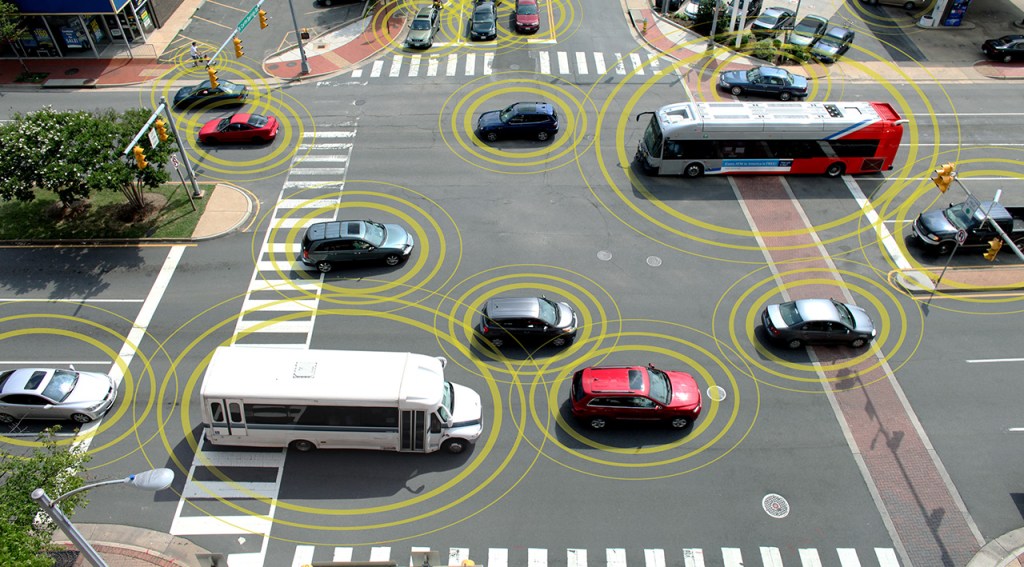
On our way to full autonomy, the term autonomous now sounds quite familiar to us because the era of automation is speeding to our reality. Although many vehicles are not fully automated, some of them are becoming more intelligent and less reliant on the driver with the use of vehicle to everything (V2X) communication technology. This wireless technology connects vehicles and any entity in the surrounding that come across. It is a vehicular communication system that includes other specific systems such as V2V (vehicle to vehicle), V2I (vehicle to infrastructure), V2N (vehicle to network), V2P (vehicle to pedestrian), V2D (vehicle to a device). In this V2X world, there is direct communication between vehicles, and between vehicle and infrastructure, pedestrians, parking lot, traffic signals, nearby road accidents which enhance safety, efficiency, and prevent collisions. It is a technology enabling smart communication management and technology agnostic connectivity on the road leading to automated driving. Its adaptive cruise control helps to control speed in heavy traffic, keeping a safe distance to the vehicle ahead. It provides on-line sight awareness by exchanging data between two or more vehicle and their surroundings, resulting in a 13% traffic accident reduction. It also serves purposes like integrating automatic payment for tolls, parking, and other similar fees
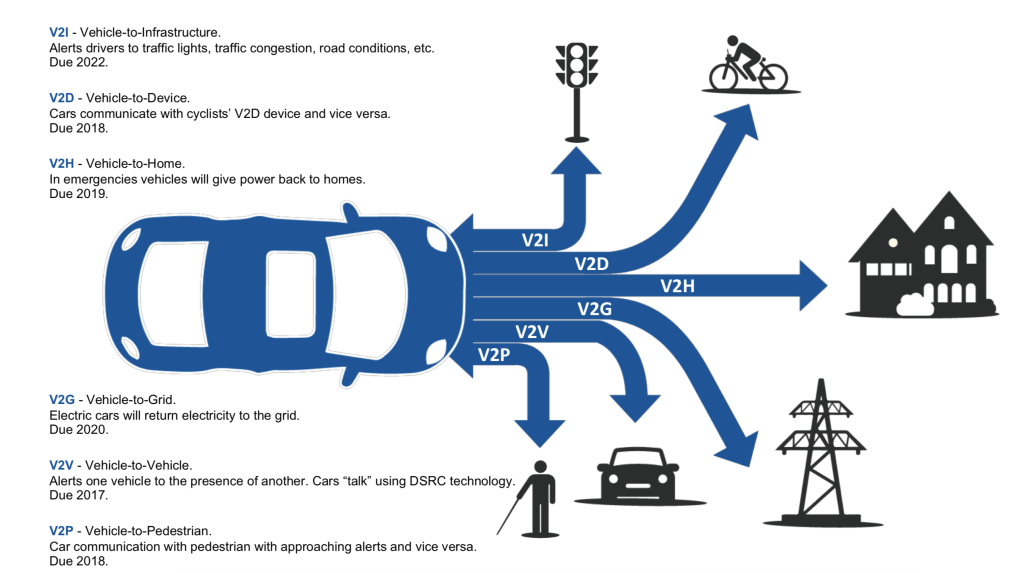
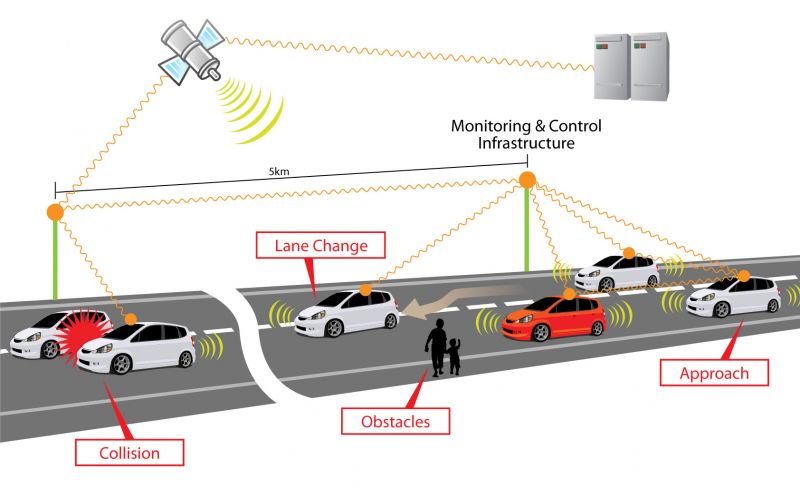
V2X technology is of two types: WLAN based and cellular-based. WLAN based V2X is referred to as Dedicated Short-Range Communication (DSRC), uses radio communication provided by 802.11p that assures safety in remote areas. It transmits messages such as safety messages, cooperative awareness messages, decentralized environmental notification service, in-vehicle information messages, and service request message. WLAN IEEE 802.11p standard is known as Wireless Access in Vehicular Environment (WAVE) in the US, and ITS-GS in Europe has characteristics such as low latency(2ms), short-range (under 1km), high reliability. Another alternative is cellular-based V2X communication uses cellular networks. The 5G vehicle to everything (V2X) equipped vehicles. Though it may be adopted in-vehicle, its effectiveness is quite limited due to the lack of smooth traffic control, uneven roads and irregular transportation management, regulatory uncertainty, and other challenges.
WLAN and C-V2X technologies are compared and adapted based on different operations such as support for low latency direct communication, network communication, and security, privacy, mobility support, and transmission frequency for periodic traffic in ITS 5.9 GHz spectrum. V2X technology based on a set of standards, in 2002, the American Society for Testing and Materials (ASTM) first published WLAN based V2X. In 2014, 3GPP stated standardization of cellular network was released. Thus, the debate on standardization of WLAN and C-V2X technology continuous with the implementation in some of the vehicles. Various studies and analyses have conducted to know the functionality effectiveness of direct communication technology from the perspective of reduction in serious injuries. This study results that C-V2X is superior to WLAN based V2X in multiple aspects such as performance, range, and reliability and significantly increases its latency, making it unusable for real-time safety applications. It includes vehicle to person and vulnerable road user communication system to detect pedestrians and cyclists to avoid collisions which is an additional advantage over WLAN based V2X. 802.11p cannot be used to integrate into 4G and 5G networks, not future proof technology.
Automotive Association (5GAA) promotes C-V2X due to its advantages. Initially, this defined as LTE in 3GPP release 14, now it supports 5G based systems and services with the direct communication between vehicles and cellular network-based communications. C-V2X uses two types of interfaces, Pc5 interface on the unlicensed 5.6 GHz band, adopted when there is direct communication between vehicle and other devices (V2V, V2I) in emergencies. On the other hand, the Uu interface on the regular licensed band cellular network used to handle vehicle to network situations concerning longer-range road hazards.
In late 2016, US National Highway Traffic Safety Administrations (NHTSA) made mandatory to deploy the vehicle to everything communication technology in all the automobile beginning from 2021. As 802.11p and C-V2X technology are competing with each other, it necessarily has standard technology by integrating into a single chipset so that only one mode of communication, adopted in different vehicles of different automakers that leads to the path of smooth traffic management throughout the area. A well as with safer autonomous driving, vehicle to everything technology also delivers business opportunities for those who back the right horse. Despite there is an ongoing debate between these two technologies, global spending on a vehicle to everything (V2X) communication technology expected to grow worldwide with an installed base of nearly 6 million.
In 2015, Toyota was the first automaker to introduce V2X technology in its Japan market models and announced it would begin deploying this technology across its line-up at the beginning of 2021. In 2017, General Motors introduced V2X in Cadillac CTS, and in 2018, GM announced it would expand this technology to more of its vehicle at the beginning of 2023. For the past couple of years, Ford has been working with Qualcomm to adopt V2X technology in their car. Audi, BMW Group, Daimler AG, Ericsson, Huawei, Intel, Nokia, and Qualcomm; eight corporations incorporated this technology.
V2X technology is likely to be adopted in vehicles of developed countries and expected to grow significantly over the next 20 years. Many top V2X suppliers, such as Delphi, Denso, Continental, and Qualcomm, have a large-scale integration plan. Vehicle to everything system becomes essential to adopt an advanced driver assistance system (ADAS) and six levels of automation in the automobile. Thus, this technology changes the concept of vehicles by using advanced computing and networking.
 Automovil & Tech